
Guest post: What Leaders Misunderstand About Safety in Small Business
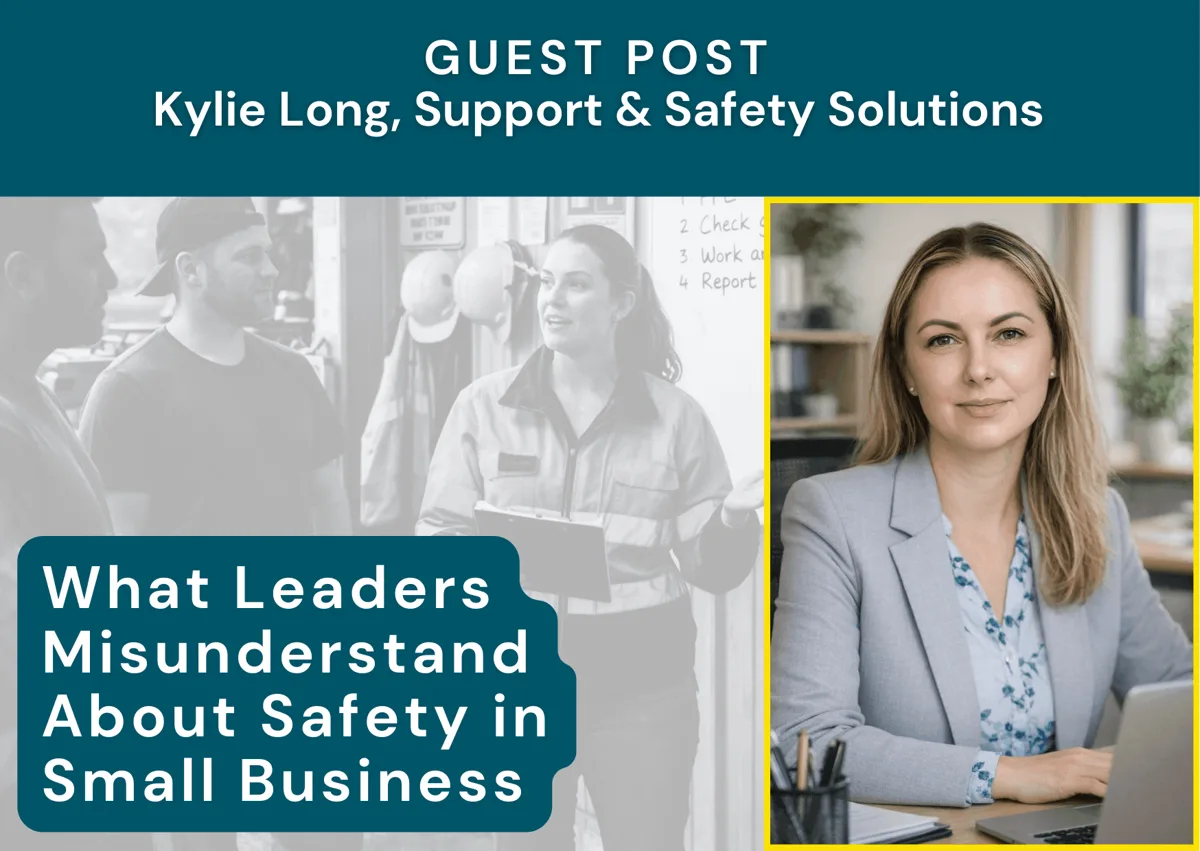
In some teams, safety in small business may be viewed as paperwork. It may be a folder or a policy or a compliance obligation that sits quietly in the background, until something goes wrong.
Safety is not paperwork, it is leadership. In small businesses it shows up in daily decisions long before it shows up in hazard and incident reports. Leadership behaviour influences risk exposure far more than a single document ever could.
Why Safety Slips
Most small business owners are not careless, they are stretched. They are managing cash flow, clients, staffing, growth and safety can quietly move down the priority list because nothing has gone wrong yet.
The issue is that risk builds long before incidents show up. In small teams especially, what the leader prioritises becomes what everyone prioritises. If safety feels optional at the top, it becomes optional everywhere.
How Leaders Accidentally Create Risk
It usually is not deliberate. It is cultural.
- Informal processes – “We all know how we do it here.”
- Verbal shortcuts – “Just be careful.”
- Old habits – “We’ve always done it this way.”
That may work until the business grows, or until someone new joins, or until a client asks for documentation or until there is a near miss. Informal systems rely on memory. Leadership requires structure.
What “Good Enough” Safety Leadership Looks Like
Small businesses do not need a corporate level safety team.
They need:
- Clear documented basics
- Defined responsibilities
- Regular risk conversations
- Systems that match business size
- A leader who visibly cares about doing it properly
It is not about creating perfection, it is about intention and protecting people and the business as it grows.
Knowing When to Get Support
There is a moment in every growing business when the “we’ll sort it later” stops being a strategy.
Usually it is when:
- The business is hiring
- The business is tendering for larger scale work
- Clients ask about WHS compliance
- Psychosocial risk obligations feel unclear
- The business is not confident systems would meet the requirements of an audit.
That is not failure. That is growth. Strong leaders recognise when specialist systems support will strengthen the business, not complicate it. Practical safety and psychosocial risk expertise can help translate legislation into workable systems without turning the business into a bureaucracy.
Safety in small business is not administrative; it is leadership in action every day in the decisions no one else sees.
Today’s post is written by Kylie Long, Founder of Support & Safety Solutions: a boutique WHS & psychosocial safety consultancy.
Kylie has over 20 years experience in workplace health and safety, psychosocial risk management, and workplace wellbeing across diverse industries such as mining, healthcare, education and government, so she knows her stuff when it comes to turning safety from compliance into culture.
See more about Kylie on her website: